The math doesn’t lie, and it’s brutal.
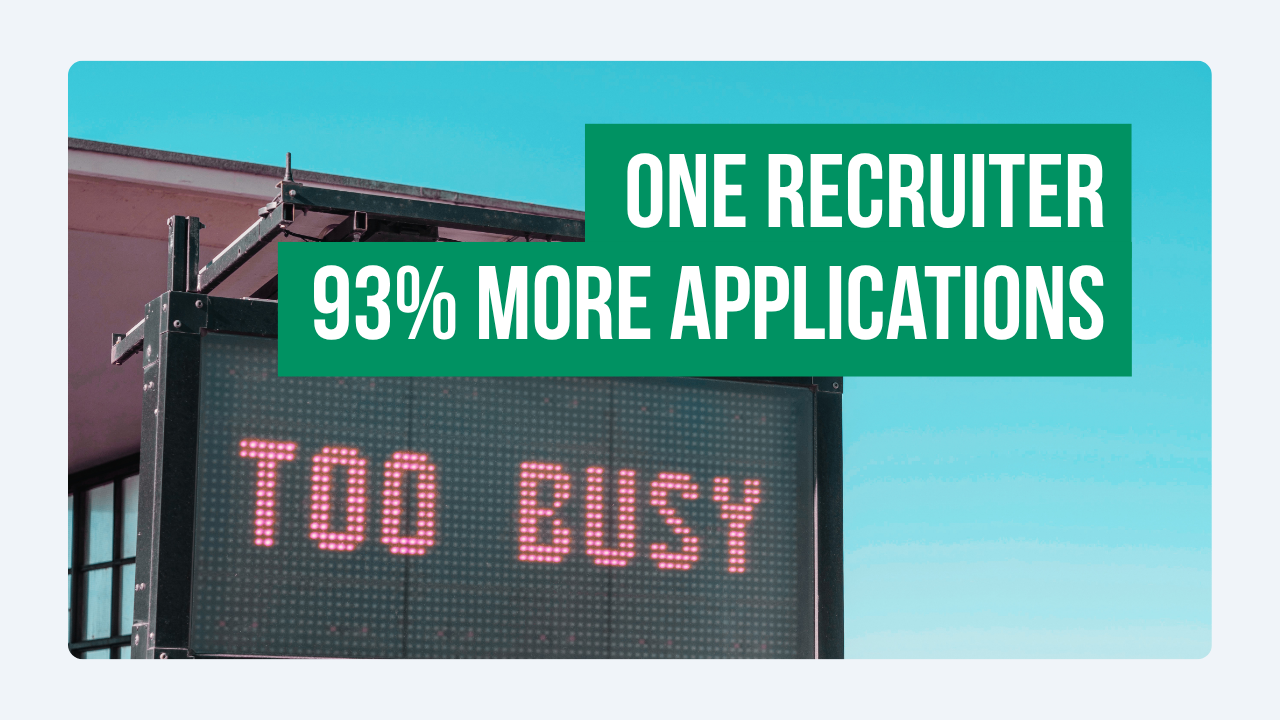
The average recruiter in 2026 is managing 13.4 open requisitions simultaneously, processing 93% more applications than in 2021, with a team that’s 14% smaller. Meanwhile, the average number of interviews per hire has increased by 33% — because companies aren’t willing to rush anymore, and one bad hire costs up to 30% of that person’s first-year salary.
More volume. Fewer people. Higher stakes. Longer processes. Welcome to recruiting in 2026.
The organizations getting through it aren’t working harder. They’re working differently.
The Breaking Point Is Already Here
When you have 200 applications per role and 13 roles open, you’re not thoughtfully evaluating each applicant. You’re pattern-matching at speed, looking for quick signals to cut the pile to something manageable.
The problem: the best candidates often don’t pattern-match well on paper. The career-changer with transferable skills, the candidate from a less recognizable employer, the person who writes a great cover letter but has a non-linear resume — these are the people who get missed when recruiters are overwhelmed.
And that’s before accounting for the hours of coordinator work: scheduling, follow-ups, feedback collection, CRM hygiene. The administrative load is eating the strategic thinking.
Something has to give.
The Agentic AI Shift
There’s an important distinction between AI that helps you do tasks faster and AI that takes tasks off your plate entirely.
AI copilots are the first generation: tools that help you write a better job description, draft a sourcing email, or summarize interview notes. Useful, but still requiring a human to initiate and complete each task.
Agentic AI is what’s reshaping lean TA teams now: systems that pursue multi-step goals autonomously, adapt to new information, and hand off to humans only when judgment is genuinely required.
Here’s what that looks like in practice:
When a new role opens, an agentic sourcing system immediately:
- Searches the existing ATS/CRM for matching past candidates (rediscovery first)
- Cross-references external talent pools for new matches
- Generates a ranked shortlist with context: fit score, last touchpoint, suggested outreach angle
- Drafts personalized outreach for recruiter review
A recruiter who previously spent 8 hours on initial sourcing now spends 20 minutes reviewing what the agent surfaced. That’s not a small efficiency gain — it’s a structural shift in how a recruiting day is spent.
During screening, AI interview agents conduct first-round structured conversations asynchronously — candidates respond on their own schedule, and the AI extracts structured competency data, flags concerns, and prepares a brief. Recruiters review the brief and move forward with the 10–15% who clear the bar. They never spend 45 minutes on a phone screen with a clearly mismatched candidate again.
For scheduling, autonomous systems coordinate between candidates and interviewers without a coordinator. One organization that implemented AI scheduling saw a 97% year-over-year increase in interview volume — same headcount. 60% of candidates self-scheduled within one hour of receiving the invitation.
The Recruiter’s New Job Description
Here’s what makes recruiting leadership nervous: if AI handles sourcing, screening, and scheduling, what are recruiters actually doing?
The answer, consistently, from the organizations seeing the best results: they’re doing the job they wanted to do when they got into recruiting.
When AI removes the administrative and high-volume processing work, recruiter time shifts to:
- Relationship-building — genuinely investing in candidates, understanding their motivations
- Hiring manager partnership — translating business needs into talent strategy, calibrating on what “great” looks like for this role
- Market intelligence — understanding talent supply in real time, advising on salary bands and competitive positioning
- Candidate experience — reducing friction, making the process feel human even when parts of it are automated
This is higher-leverage work. It’s also more sustainable, more interesting, and what defines recruiting as a real profession rather than a high-volume processing job.
The Quality of Hire Dividend
There’s an underappreciated benefit that goes beyond efficiency.
When recruiters aren’t buried in volume, they make better decisions. When AI handles consistent first-round screening with structured criteria, you get comparable data across candidates. When interview intelligence captures detailed competency assessments rather than impressionistic notes, you have something useful to analyze later.
The companies winning on talent density right now — the ones where hiring manager satisfaction scores and new hire retention are both improving — aren’t just moving faster. They’re more systematic.
Quality of Hire is increasingly the metric that boards and leadership actually care about. McKinsey links top performers to being 800% more productive than average in the same role. A single great hire at a senior level can reshape a team. A single bad one costs multiples of their salary to unwind.
Lean TA teams armed with AI don’t just hire more. They hire better.
Getting Lean Right
A few principles from the organizations doing this well:
Start with rediscovery, not new sourcing. Before activating any external channel on a new req, check what you already have. AI makes this fast. Your ATS is an underutilized asset.
Automate the repetitive, preserve the human moments. Scheduling, first-round screening briefs, pipeline status updates — all automatable. Final-stage conversations, offers, difficult feedback — keep humans.
Invest in structured data, not just speed. AI that moves candidates faster is useful. AI that generates consistent, comparable evaluation data is transformative. The former saves recruiter time; the latter improves hiring decisions.
Measure differently. Time-to-fill and cost-per-hire are still relevant. Add: Quality of Hire indicators at 30/90 days, funnel conversion rates by source, and interview-to-offer accuracy. These tell you whether you’re getting better, not just faster.
One recruiter managing 13 requisitions isn’t a tragedy if the right infrastructure is in place. It might actually be the future of a healthy, high-output TA function.
Casuro’s AI interview platform lets lean recruiting teams conduct structured, high-quality interviews at scale — so you spend your time on the conversations that actually matter. See how teams use it →