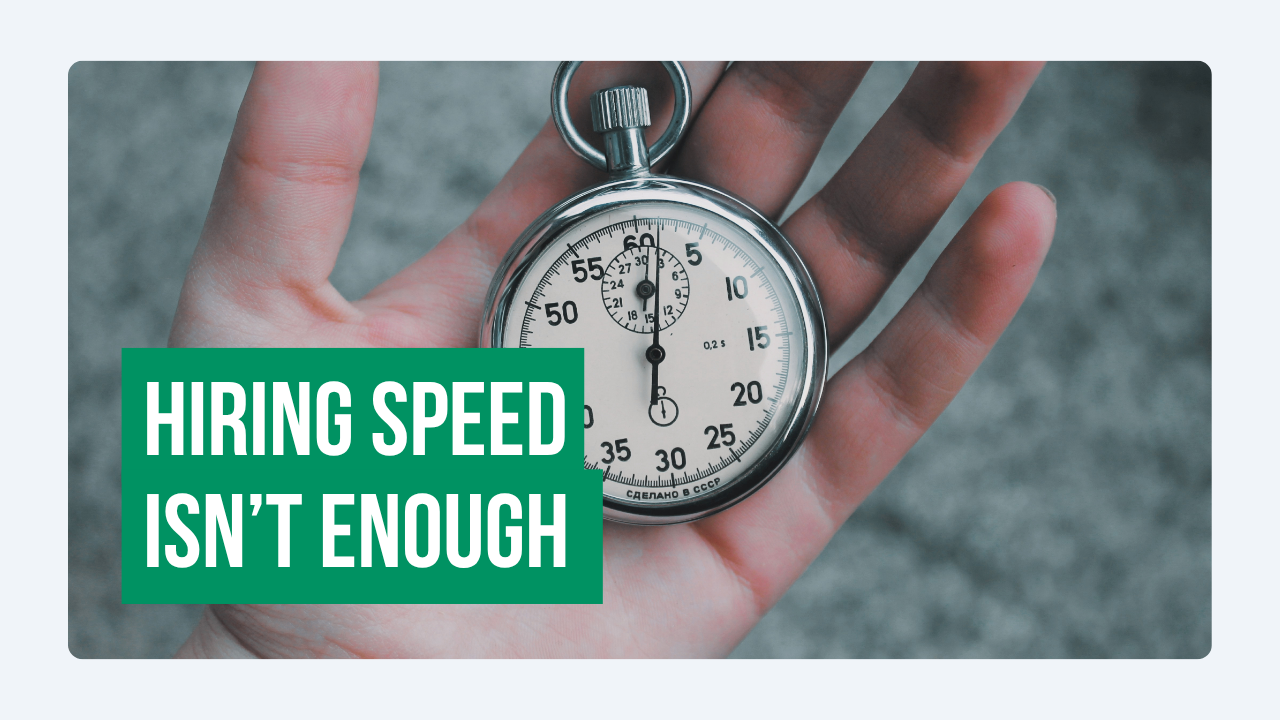
The average time-to-fill dropped by 18 days at companies that adopted AI screening in 2025. Nobody talks about what happened to quality.
Speed was always the easy pitch
When AI recruiting tools started going mainstream in 2023, every vendor demo led with the same number: how fast their tool could screen a thousand applicants.
It worked. TA leaders, crushed under application volume and pressure to hit headcount targets, bought in. The logic seemed airtight — if you could cut time-to-fill, you’d hit targets faster, satisfy hiring managers, and free up recruiter bandwidth. Speed was measurable. Speed was fundable.
The problem is that speed was never the actual constraint.
Fast bad hires are just expensive bad hires
The average cost of a bad hire is still cited at 30% of first-year salary. For a $120,000 role, that’s $36,000 — in lost productivity, manager time, and rehiring costs. Add severance and the real number climbs higher.
AI screening that filters fast doesn’t change that math. If anything, it accelerates it. You’re running more candidates through a funnel that terminates at the same broken interview process, just 18 days sooner.
“Speed isn’t enough. Talent decisions need domain-specific intelligence, not just throughput.”
That’s from Findem’s 2026 positioning — and they’re not alone in making this pivot. HackerRank’s research arm has been publishing similar arguments: “The case for AI interviews isn’t efficiency. It’s quality.” Multiple vendors are independently arriving at the same correction.
What the shift actually looks like
Teams that are outperforming on Quality of Hire in 2026 share a few patterns:
They measure signal, not throughput. The question isn’t “how many applicants did we screen this week?” It’s “how predictive was our screen?” That requires tracking what happens to the candidates you pass through — do they convert to offer, accept, and actually perform?
They’ve invested in the interview layer. Screening AI is good at filtering noise. It’s bad at generating the nuanced signal you need to make a confident hire. The teams doing best have built structured interview processes downstream of AI screening — not replaced the interview with automation.
They’ve accepted a harder metric. Time-to-fill is easy to report. Predictive validity is harder to measure and takes months of data to validate. Most organizations haven’t built the feedback loop. The ones that have are now hiring measurably better.
The vendors are catching up to this
The market is starting to reflect it. Ashby built their entire product around structured hiring data — scorecards, calibration, interview analytics. Gem’s benchmark reports have shifted from “messages sent” to pipeline health metrics. The language across the category is changing from “automate your screening” to “improve your hiring decisions.”
That’s the right direction. But most TA teams are still running on 2024 success metrics.
The uncomfortable truth about 2025
A lot of companies adopted AI recruiting tools, hit their time-to-fill targets, and declared victory. They’ll feel the downstream effects this year. Attrition, performance issues, and manager dissatisfaction that gets attributed to anything but the hiring process.
The teams that will outperform in 2026 are the ones that ask a harder question: not “how fast are we hiring?” but “are we hiring the right people?”
Casuro helps teams close that loop — structured AI interviews that generate consistent, comparable signal on every candidate, so decisions are made on data, not gut feel. See how it works →