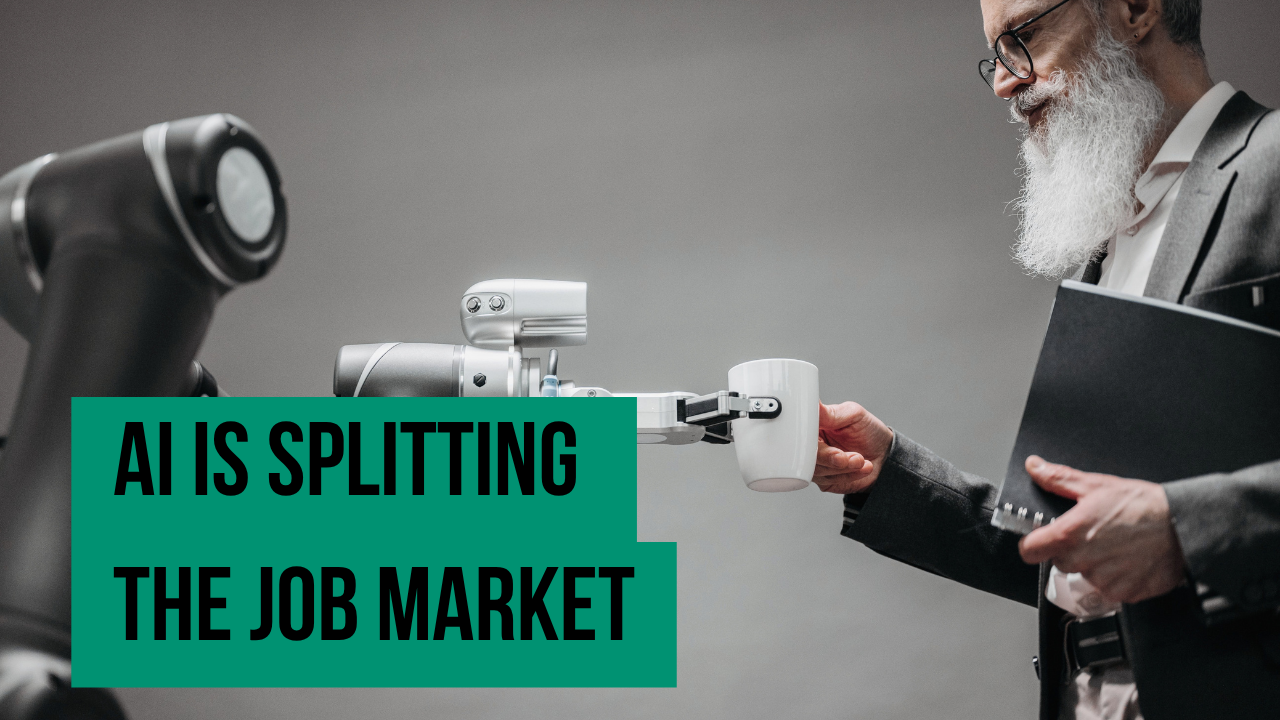
The data is in. AI isn’t flattening the labor market — it’s fracturing it.
PwC’s 2026 Global AI Jobs Barometer, released June 15 and based on over one billion job ads across six continents, identifies a clear split emerging across every industry: a “professionalized” track and a “democratized” track. Which one your role lands on determines your salary trajectory, your job security, and how much you’ll be expected to do in five years. For operators and HR leaders, it also determines where your hiring strategy needs to go right now.
The Two Tracks, Defined
In professionalized roles, so typically highly academic roles, such as radiologists, recruiters, financial analysts, software engineers — AI takes over routine and repetitive work, pushing the human left in the job toward higher-order judgment, creativity, and domain expertise. These roles are getting harder, not easier – even more competitive. And they’re being paid accordingly.
In democratized roles, such IT service managers, medical secretaries, data entry workers, first-tier support agents — AI makes the job itself easier for a non-expert to perform. Democratization in this context thus means making it more available and less exclusive. The barrier to entry drops. So does the wage.
PwC found that professionalized roles are seeing twice the job growth of democratized ones, and 42% faster salary growth. The AI skills wage premium has hit 62% — up from 57% just last year. These aren’t marginal effects. The labor market is repricing in real time.
The Widening Gap Between Companies
It’s not just jobs who are diverging. The same split is playing out at the company level.
The most AI-exposed companies achieved labor productivity growth of 163% relative to a 2018 baseline — nearly five times higher than the broader group of AI-exposed companies. Headcount growth at these firms is also outpacing their less-exposed peers: 52% vs. 36% since 2018. That’s the counterintuitive part. The companies leaning hardest into AI aren’t cutting people — they’re hiring more of them, but demanding more from each hire.
For founders and operators, this is the core tension to sit with: AI adoption alone is not an edge. According to a February 2026 NBER study of nearly 6,000 senior executives across the US, UK, Germany, and Australia, roughly 90% of firms that have adopted AI report no measurable impact on either employment or productivity over the past three years. Globally, $2.5 trillion is being spent on AI in 2026 — and most of it is not moving the needle yet.
The key takeaway is the productivity gains are real, but they’re concentrated in a small number of firms doing something different: AI-native over AI-enabled – restructuring work around AI, not just adding tools on top of existing workflows.
What’s Happening at the Entry Level
Perhaps the sharpest signal in the PwC data is what’s happening to entry-level jobs. Based on an analysis of 2.4 million entry-level positions in the US, roles most affected by AI are now seven times more likely to require traditionally senior-level competencies — leadership, creativity, interpersonal influence. Since 2019, “up-skilled” entry-level positions have grown 35%, while conventional entry-level roles have declined 10%.
This reshapes how companies should hire junior talent. The old model — hire someone green, let them learn the basics, promote from within after a few years is disappearing, because it is simply not working well. Entry-level candidates are increasingly expected to arrive with the judgment and communication skills that used to take years to develop. AI handles the ramp; humans are expected to be ready sooner. The question remains – how can you test that?
The SHRM State of AI in HR 2026 Report backs this up from inside HR teams themselves: 57% of HR professionals report that AI implementation is primarily driving upskilling and reskilling among employees, while only 7% say it has led to displacement. The story isn’t about replacement — it’s about acceleration.
What This Means for Hiring Right Now
Three things follow from this data for anyone building or growing a team in 2026:
AI exposure is a hiring signal, not a job requirement. Candidates who understand how to work with AI tools and adapt to them as they evolve belong on the professionalized track. They’ll be faster, more productive, and less replaceable. It is crucial to screen for adaptability alongside domain expertise.
Job descriptions need to reflect the up-skilled baseline. If your entry-level roles now require senior-level judgment, your hiring bar and your compensation should reflect that. Offering junior wages for professionalized work will hollow out your pipeline. And more importantly ways to measure senior-level judgement and AI capabilities need to be scaled to speed up and improve hiring quality.
The gap between AI leaders and laggards is compounding. With a 163% productivity advantage and faster hiring, AI-forward companies aren’t waiting. If your organization is in the 90% that hasn’t yet seen measurable returns from AI, the issue is almost certainly implementation, not adoption. Deploying tools isn’t enough, you need to restructure workflows around them. Do not AI-enable, become AI-native.
Casuro can help you find people of all career stages, who know how to excel with AI. AI-native over AI-enabled to make a difference and bring your business forward.
Sources
Picture credits by Pavel Danilyuk
- PwC 2026 Global AI Jobs Barometer — Press Release
- PwC 2026 Global AI Jobs Barometer — Full Report
- NBER Working Paper: AI, Productivity, and Labor Markets (w34984)
- Fortune: Thousands of CEOs Admit AI Had No Impact on Productivity
- SHRM: State of AI in HR 2026 Report
- S&P Global: AI Impact on Employment 2026