
Something quietly broke in the talent pipeline this year. Unemployment among recent college graduates has climbed to nearly 6% — rising twice as fast as the rest of the workforce since 2022. Entry-level job postings in the US have dropped by 35% over the last 18 months. And 39% of business leaders say they’ve already reduced or eliminated entry-level roles due to AI.
So — is AI eating the bottom rung of the career ladder? The answer, as with most things in 2026, is complicated.
The Traditional Entry-Level Job Was Already Fragile
Entry-level roles existed for a reason: they gave new graduates somewhere to learn the ropes while doing the repetitive, foundational work that kept companies running. Think data entry, first-draft writing, basic research, QA testing, customer support triaging. These tasks weren’t glamorous, but they were how people built professional judgment.
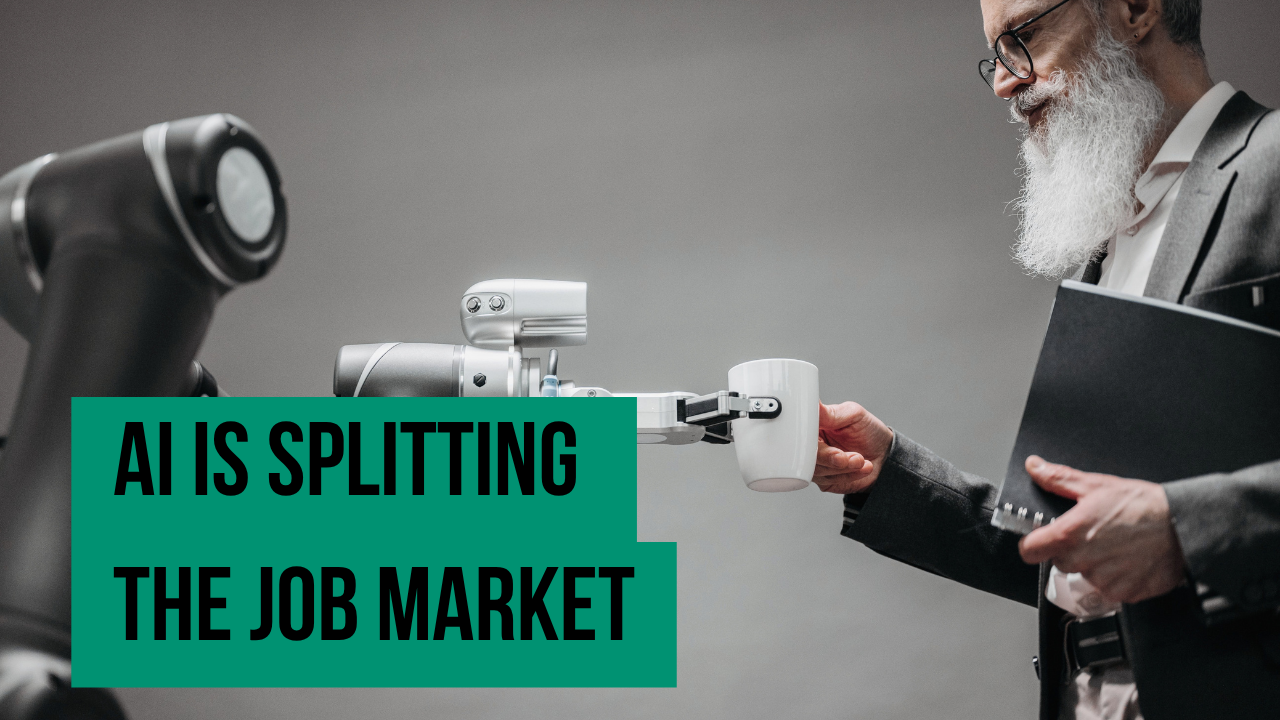
AI now does many of these things faster and cheaper. Agentic AI tools can handle first drafts, summarize research, triage tickets, and process documents at scale. The economics are hard to argue with — and companies aren’t pretending otherwise.
The Numbers Tell Two Stories
One camp paints a stark picture: 43% of business leaders expect to cut entry-level headcount further in 2026. The traditional path from education to employment is eroding. The Class of 2026 is graduating into a market that has fewer on-ramps than any cohort in recent memory.
The other camp pushes back. McKinsey is increasing North American hiring by 12% this year. IBM has announced plans to triple its US entry-level hiring. BCG’s latest research argues that AI will reshape more jobs than it replaces — and that the skills deficit is not in AI, but in critical thinking and judgment, which humans still need to develop somewhere.
There’s also a more cynical finding in the data: a Resume.org survey found that 59% of companies admit to citing AI as the reason for layoffs because “it plays better with stakeholders than citing financial constraints.” Not every AI-related job cut is what it appears to be.
The Real Debate: Where Do Junior Employees Learn?
This is the question that keeps HR leaders up at night. If AI handles the foundational work, where do the senior employees of 2030 get their experience?
The traditional model worked because grunt work was also training. A junior analyst who spent two years cleaning data learned how data breaks, where errors hide, and what good data looks like. A junior copywriter who rewrote a hundred product descriptions developed instincts about clarity, voice, and what resonates.
Take away that work, and you take away the training ground. You can’t skip the junior years and then expect senior-level judgment to appear.
Some companies are experimenting with new models: structured AI-supervised apprenticeships, rotational programs focused on AI oversight and prompt engineering, and hybrid roles where junior hires manage AI outputs rather than produce first drafts themselves. Whether these approaches actually build career-defining skills — or just create a generation of prompt jockeys — is still an open question.
What the AI-Native Worker Actually Looks Like
Gen Z entering the workforce in 2026 is the first cohort that’s never worked without AI tools. They’re fluent in Copilot, Claude, and a dozen other assistants the way earlier generations were fluent in Excel. Workers with strong AI proficiency save an average of nine hours per week and are five times more productive than peers who don’t use AI.
But here’s the tension: 73% of talent acquisition leaders say the skill they most need right now is critical thinking and problem-solving — AI proficiency ranks fifth. Speed and output are abundant. Judgment is scarce.
The AI-native workforce is powerful. It’s also, in some ways, less tested. When AI does the heavy lifting, the question is whether the human using it is actually learning — or just operating a very capable tool they don’t fully understand.
What This Means If You’re Hiring (or Job Hunting)
For employers: the entry-level pipeline problem is not hypothetical. If you automate away the training ground, you’ll face a senior talent shortage in 3–5 years. The companies winning at this are designing roles around AI oversight, judgment, and iteration — not just replacing headcount with tools.
For job seekers: AI fluency is table stakes, not a differentiator. What sets candidates apart in 2026 is the ability to think critically, communicate clearly, and make good decisions under uncertainty. Those are the skills AI doesn’t generate — and that hiring managers are increasingly desperate to find.
The bottom rung of the career ladder isn’t gone. But it has moved, and the climb looks different now.
Sources: Gloat AI Workforce Trends Q2 2026 · Fortune: AI Entry-Level Jobs · HR Dive: AI and the Entry-Level Pipeline · BCG: AI Will Reshape More Jobs Than It Replaces · Revature: 2026 IT Workforce Prediction · WEF: How AI Is Changing Entry-Level Work